

Photo Credit; Getty Images
A year ago, they struggled to keep pace. On Sunday, one machine left humanity behind.
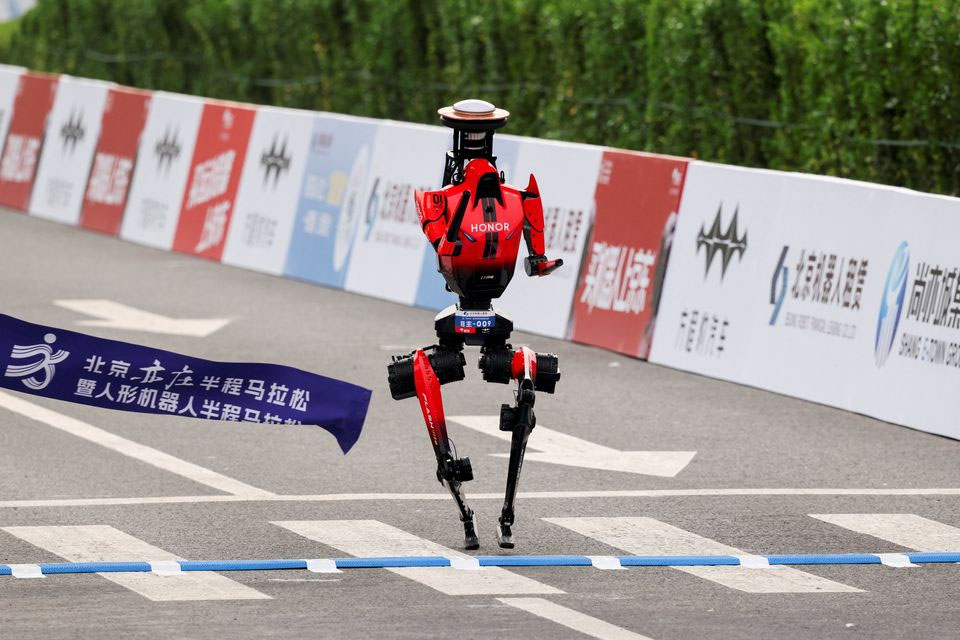
A humanoid robot built by Honor surged past thousands of runners to complete a half-marathon in a time no human has ever reached, signaling a dramatic leap in robotics performance and ambition.
Nicknamed "Lightning," the bright-red android covered the 21-kilometer course in just 50 minutes and 26 seconds, comfortably beating the human world record of 57 minutes and 20 seconds set by Jacob Kiplimo. With smooth, rhythmic strides and compact arm swings for balance, the 169-centimeter-tall robot showed no visible fatigue as it crossed the finish line.
The result marked a stark contrast from last year's inaugural humanoid race, where most machines failed to finish and the winning robot lagged far behind elite human athletes. This time, more than 100 teams entered—five times as many as before—and several robots outperformed professional runners.
Organizers said advances in autonomous navigation and power efficiency were decisive. Nearly half of the participating robots completed the course without remote control, navigating terrain independently while running on parallel tracks alongside 12,000 human participants.
Engineers behind the winning design revealed the robot had been in development for about a year, with leg structures modeled on elite athletes and cooling systems adapted from smartphone technology. The improvements reflect broader momentum in China's robotics sector, which has been heavily backed by government policy and investment.
Spectators watched a wide range of humanoids—varying in size, gait, and speed—demonstrating how quickly the technology is evolving. While the spectacle captivated audiences, experts noted that translating such athletic performance into real-world industrial use remains a challenge.
Still, the race underscored China's growing confidence in a field it considers critical to future economic and technological leadership. From factory automation to hazardous work environments, developers believe humanoid robots could eventually reshape multiple industries.
For now, one thing is clear: in this race, the future didn't just arrive—it ran past.