

Photo Credit: Getty Images
SpaceX's massive Starship rocket has reached orbit for the first time, marking a major milestone for Elon Musk's space company, although the test flight ended several hours earlier than planned.
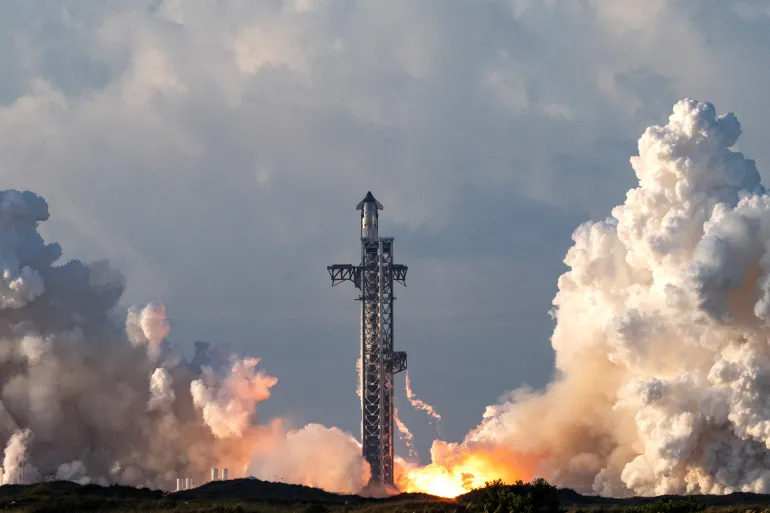
The uncrewed rocket lifted off from SpaceX's Starbase facility in Texas on Monday, Sept. 28, beginning what was supposed to be a roughly 10-hour journey around Earth.
Instead, the company decided to bring Starship back after about three hours in orbit.
The mission got off to a tense start when one of Starship's engines shut down earlier than expected during the ascent. At one point, SpaceX said the problem meant the vehicle might not be able to continue with its planned orbital attempt. Engineers later determined that the remaining engines could still carry out the necessary maneuver, allowing Starship to successfully reach orbit.
"Starship is orbital," Mission Control announced as cheers erupted at the launch site.
Once in orbit, the spacecraft deployed 26 next-generation Starlink V3 satellites. SpaceX said all 26 were successfully deployed and operating, marking the first time Starship has delivered satellites during an orbital mission.
The achievement was significant for another reason: Monday's flight was Starship's first commercial mission, with the spacecraft carrying an operational payload rather than serving solely as a test vehicle.
The original plan called for Starship to remain in orbit for around 10 hours and complete several trips around Earth before splashing down in the Pacific near Chile.
Instead, SpaceX said flight teams would deorbit the spacecraft into a pre-cleared area of the Pacific after three hours.
The vehicle ultimately reentered over the Pacific and splashed down north of Hawaii. The dramatic landing ended with Starship tipping over and being engulfed in flames. The spacecraft was not expected to be recovered from the ocean.
Despite the shortened flight and engine problem, NASA Administrator Jared Isaacman congratulated SpaceX, praising the team for getting Starship into orbit and handling the mission safely.
Monday's launch was Starship's 14th full-scale flight since testing began in 2023. Previous missions had reached space but stopped short of completing an orbital flight, making this mission an important test of whether the 407-foot rocket can eventually become a reliable orbital vehicle.
SpaceX is developing Starship for much bigger jobs, including launching large numbers of Starlink satellites and carrying astronauts and cargo to the Moon. NASA also plans to rely on a version of Starship as part of its Artemis lunar program.