

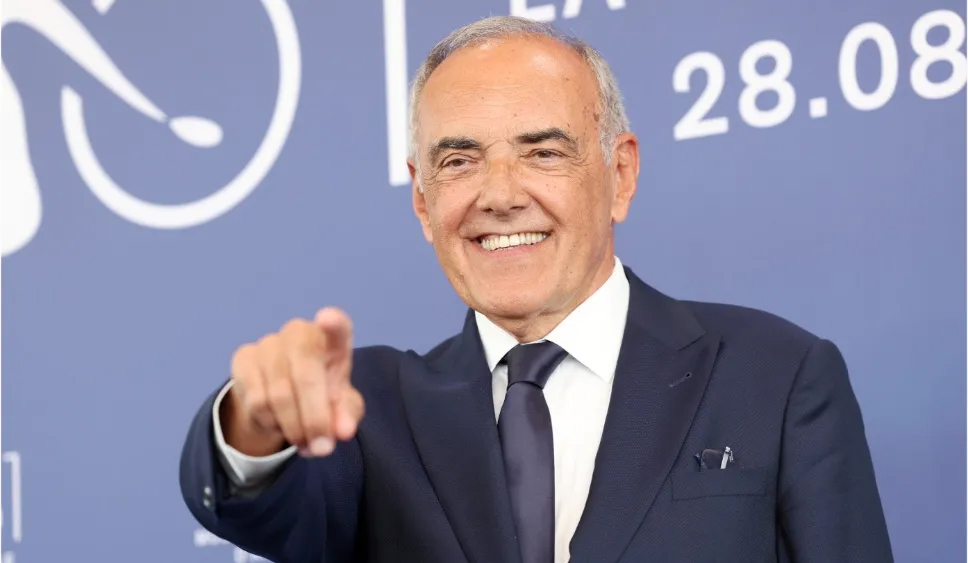
Photo Credit: Getty Images
Venice Film Festival artistic director Alberto Barbera has unveiled what he calls one of the most exciting and diverse lineups in recent memory, reinforcing the Lido’s role as a global launchpad for awards contenders and auteur-driven cinema. Speaking just hours after the official announcement, Barbera opened up about the return of Netflix, the evolving state of American and global film industries, and the surprising Oscar potential of Dwayne Johnson.
Barbera, who has led the festival since 2012, shared his satisfaction with this year’s slate. “I’d say we got close to 98 percent of the most anticipated films,” he said. “It’s a very well-assorted program. As always, we have the big name directors. But we also have surprises, new talents, and films from underrepresented areas.”
Among the more high-profile topics was Netflix’s strong return to the Venice competition lineup after skipping last year. The streaming giant brings three titles into the main competition: Kathryn Bigelow’s A House of Dynamite, Noah Baumbach’s Jay Kelly, and Guillermo del Toro’s long-gestating Frankenstein. Notably absent is Edward Berger’s Ballad of a Small Player, another Netflix production. “I never talk about films we don’t have,” Barbera stated, adding that four Netflix films in competition would have been excessive. “Three is the right number,” he explained, preempting criticism of favoring streamers.
Asked about the state of American cinema, Barbera pointed to a noticeable absence of major studio films. “The U.S. studios are still searching for a new identity,” he said, referencing the aftershocks of industry strikes and the pivot to streaming. “All of the many American films in Venice are either from the indie sector or from the streamers, especially Netflix and Amazon.” According to Barbera, while streamers produce massive volumes of content, few titles qualify as auteur cinema, though the ones that do are increasingly vital to the global film ecosystem.
On international cinema, Barbera described a polarized landscape. British cinema, he noted, sits between U.S. influence and its own indie output, with encouraging signs of co-productions despite Brexit. French and Italian cinema remain strong, but political instability is impacting output from regions like Southeast Asia, Latin America, and Africa. “Brazil is totally absent,” Barbera said, blaming former President Jair Bolsonaro’s hostility toward auteur cinema. Argentina, now under Javier Milei, risks the same fate. Still, Barbera sees Africa as a continent with rising cinematic potential.
One of the most buzzed-about films is Benny Safdie’s The Smashing Machine, starring Dwayne Johnson and Emily Blunt. Contrary to expectations, the film will compete for the Golden Lion. “Dwayne Johnson is amazing in the film,” Barbera revealed. “Their performances really blew us away.” What began as a presumed out-of-competition spectacle turned out to be, in Barbera’s words, “a really great movie about two great characters.” Based on the life of wrestling legend Mark Kerr, the film not only impressed Barbera, but may also be headed for Oscar attention, with A24 reportedly preparing an awards campaign.
With Netflix back, a reshaped American presence, and an increasingly global scope, this year’s Venice Film Festival signals not just a celebration of cinema, but a moment of reckoning, and resurgence for the film industry at large.