

Photo Credit; Getty Images
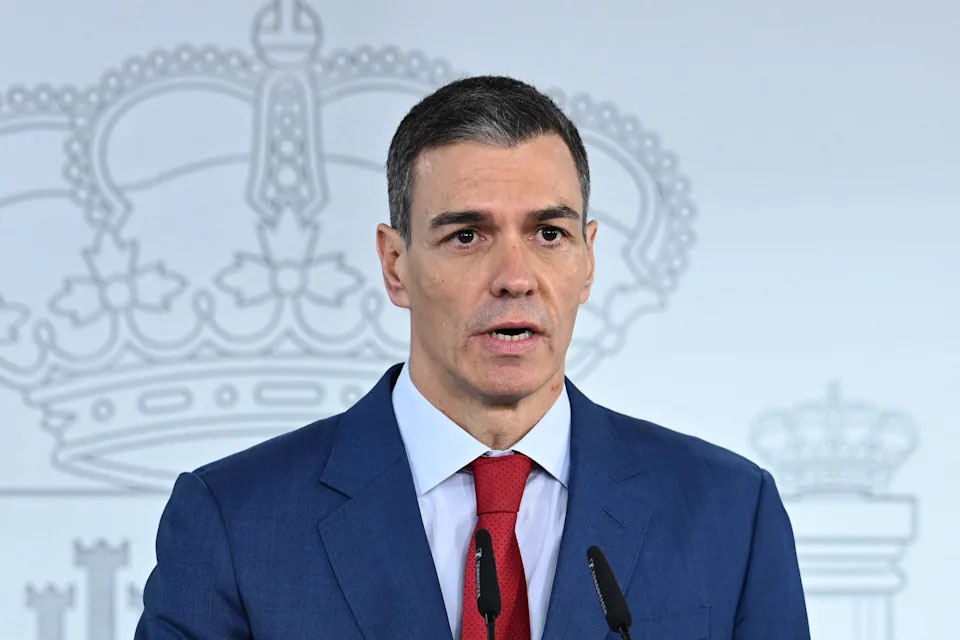
Spanish Prime Minister Pedro Sánchez has issued a forceful response to US President Donald Trump after Trump threatened to sever trade ties with Spain. Speaking in a televised address from the prime minister’s official residence in Madrid, Sánchez defended his government’s foreign policy stance and repeated a message that he said defines Spain’s position in the current global climate: “no to war.”
The address came a day after Trump declared he did not want “anything to do” with Spain and warned of a full trade embargo. The threat followed Spain’s refusal to allow the United States to use the jointly operated military bases at Morón and Rota for strikes against Iran. During a meeting with German Chancellor Friedrich Merz, Trump described Spain as a “terrible partner” and criticized the country for not meeting NATO’s target of allocating 5 percent of its gross domestic product to defense spending.
Sánchez did not directly mention the trade threat in his speech, but he made clear that Spain would not support actions that undermine international law. Reflecting on the wars in Ukraine and Gaza, as well as the 2003 invasion of Iraq, he argued that responding to one illegality with another only deepens global instability. “The question is not whether we are on the side of the ayatollahs,” he said. “Nobody is. The question is whether we are in favor of peace and international legality.”
Spain has taken one of the strongest positions in Europe regarding the war in Gaza, criticizing Israel’s military campaign and recognizing a Palestinian state earlier than many other European Union members. Sánchez linked this stance to Spain’s broader foreign policy principles, emphasizing consistency in opposing what he called the breakdown of international law.
He also invoked memories of the Iraq War, a deeply divisive episode in Spanish politics. Spain’s support for the US led invasion under then Prime Minister José María Aznar
triggered massive protests and political backlash. Sánchez reminded viewers of the so called Azores meeting, where former US President George W. Bush, former UK Prime Minister Tony Blair, and Aznar gathered ahead of the invasion. He described the outcome as a more insecure world that ultimately harmed ordinary citizens.
International support for Spain has followed Trump’s remarks. The Élysée Palace confirmed that French President Emmanuel Macron expressed solidarity with Sánchez. European Council President António Costa also conveyed the European Union’s full backing during a phone call with the Spanish leader.
Domestically, Sánchez faces mounting political pressure. His coalition government has struggled to maintain its parliamentary majority amid corruption allegations involving several allies. Spain’s political landscape remains sharply polarized, and his leadership has often been challenged by both conservative and far right parties. However, standing up to Trump could prove politically advantageous. A recent poll by the CIS research institute found that 77 percent of Spaniards hold a negative opinion of the US president.
Despite strong rhetoric on both sides, uncertainty remains over whether Trump’s threats will materialize into concrete economic measures. For now, Spain’s government says it is studying possible steps to shield its economy from any fallout. As tensions rise, many Spaniards are watching closely, aware that decisions made in Washington and Madrid could have lasting consequences for trade, diplomacy, and regional stability.






