

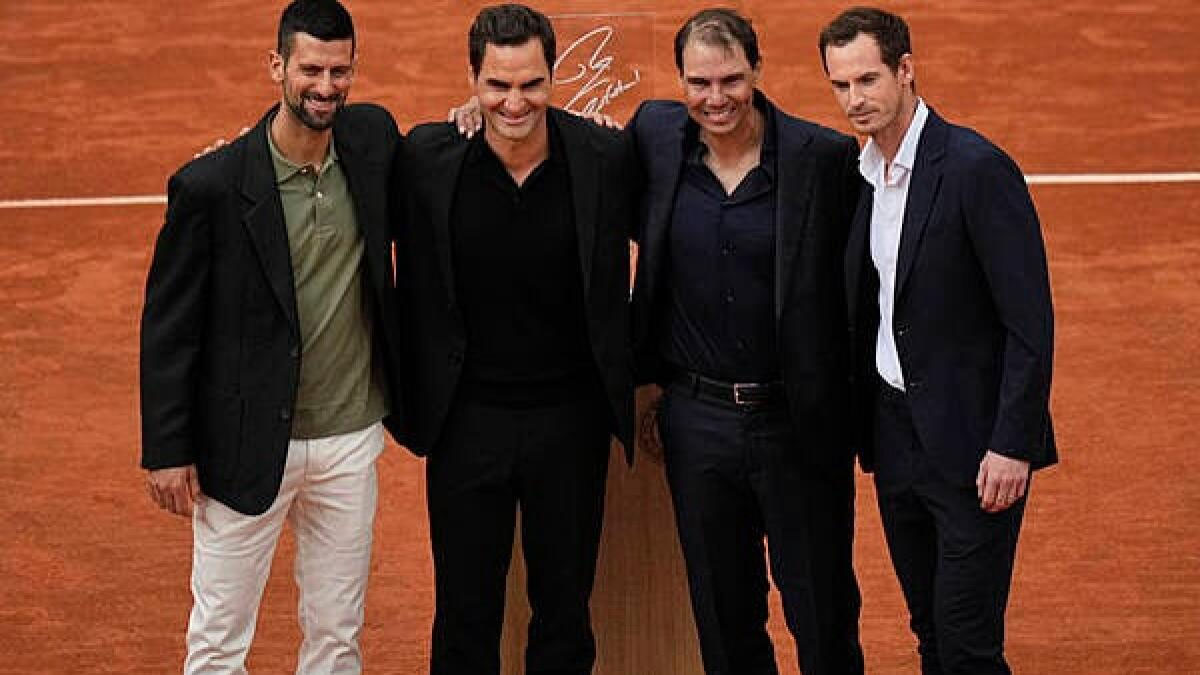
Photo Credit: Getty Images
For more than two decades, built a legacy that transformed him into one of the greatest athletes in tennis history. From lifting Grand Slam trophies to dominating the clay courts of Roland Garros, Nadal became a symbol of determination, discipline and resilience. However, the new four part Netflix documentary series Rafa offers fans something they have rarely seen before: the vulnerable and deeply personal side of the tennis icon.
The documentary, directed by , premiered on Netflix this Friday and explores Nadal’s mentality, injuries, family life and the sacrifices that shaped his legendary career. Despite being known globally as one of the greatest winners in sport, Nadal surprisingly says he sees himself more as a competitor than a winner.
“When I say I am more a competitor than a winner it’s because what I enjoyed the most is the competition,” Nadal explained in an interview in Madrid. “I like to win, yes, but I don’t hate to lose. What I hate is not feeling myself competitive.”
The statement captures the essence of Nadal’s career. His passion was never simply about collecting trophies, but about the intensity of battle and pushing himself beyond limits. Nadal reflected on his dominant victory against in the 2008 French Open final, admitting that the easy win was not as emotionally satisfying as the difficult matches he played on the road to the final.
According to Nadal, the toughest and most competitive matches brought him the greatest satisfaction because they tested both his skill and mentality. That fierce competitive spirit became one of the defining features of his career and helped him earn the nickname “King of Clay” after winning the French Open an astonishing 14 times.
The documentary also reveals how close Nadal came to losing his career early because of serious injuries. In 2004 and 2005, he suffered stress fractures in his foot and doctors later discovered he had Mueller Weiss syndrome, a rare condition affecting the navicular bone in the foot. At the time, medical experts feared he might never continue playing professional tennis.
Nadal explained that after struggling to find a solution, doctors created a special insole that pushed his foot upward inside his shoe, allowing him to continue competing. Although the insole helped save his career, it also contributed to long term physical problems involving his knees, hip, back and other parts of his body.
Throughout his career, Nadal battled constant injuries and was forced to miss 18 Grand Slam tournaments. Despite the pain, he continued fighting and competing at the highest level. The documentary shows how his refusal to give up became central to his identity as an athlete.
Director Heinzerling says the series attempts to answer an important question: why Nadal continued playing even when his body was clearly struggling. According to the filmmaker, Nadal never took his career for granted after being told early on that it could all end at any moment.
The series also offers viewers a rare glimpse into Nadal’s private life. Cameras entered his home and captured moments with his wife, , and their children. Nadal admitted that opening up in such a personal way was difficult at first, but he believed that if he was going to make a documentary, it had to be done honestly.
“When you film a documentary, you do it or you don’t do it,” Nadal said. “If you do it, do it the proper way.”
Now retired after his final French Open appearance in 2024, Nadal says he is enjoying life away from professional tennis. Although he continues to work and travel more than expected, he is focused on spending time with his family and embracing a new chapter in life.
The documentary ultimately presents Nadal not only as a tennis legend, but also as a human being who endured pain, pressure and uncertainty while inspiring millions around the world through perseverance and passion.