

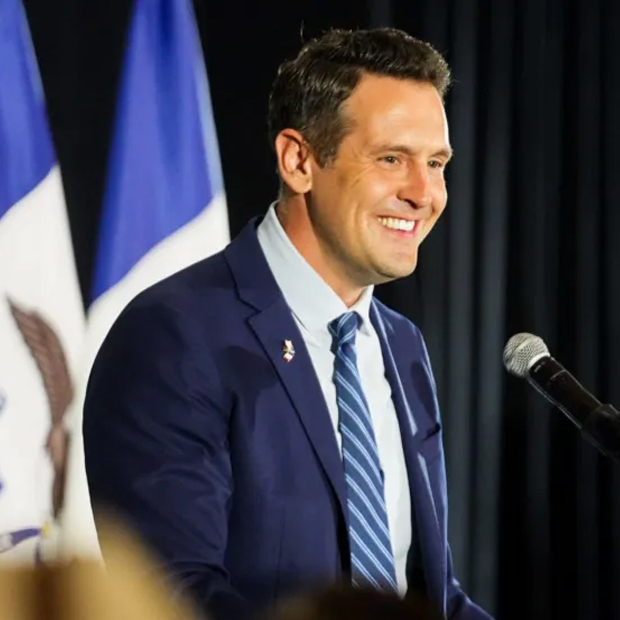
Photo Credit: Getty Images
A closely watched Republican primary race in the US state of Iowa has delivered a surprising result after Randy Feenstra, a candidate endorsed by President Donald Trump, lost his bid to secure his party’s nomination for governor.
Feenstra, a three term Iowa congressman and a reliable supporter of Trump, had been viewed by many political observers as the frontrunner in the contest. His campaign received a major boost shortly before voting when Trump publicly endorsed him. However, despite the backing of the president, Feenstra conceded defeat on Tuesday after being beaten by farmer and businessman Zach Lahn.
Lahn’s victory highlights the growing influence of grassroots conservative movements within the Republican Party. Throughout his campaign, he embraced a message that closely reflected many of Trump’s own political themes. His slogans included “Make Iowa Healthy Again” and “Iowa First”, while his policy positions focused heavily on limiting foreign and out of state ownership of Iowa land. He also criticized what he described as “global elites”, a message that resonated with many conservative voters.
The successful candidate received strong support from Turning Point USA and grassroots conservatives across Iowa who believed Feenstra had become too closely associated with the Washington political establishment. For many voters, Lahn represented a fresh alternative despite Feenstra’s established political profile and endorsement from Trump.
The result has attracted national attention because it represents a rare setback for Trump’s political endorsements. In recent weeks, candidates supported by the president have generally enjoyed considerable success in Republican primary races. Political analysts have noted that Trump’s endorsement has often been viewed as a powerful advantage capable of influencing election outcomes.
However, the Iowa result suggests that local issues and voter concerns can sometimes outweigh presidential backing. Iowa farmers have faced economic challenges linked to trade disputes and tariff policies. The state’s agricultural sector has also experienced pressure from rising fuel and fertilizer costs following recent international tensions and conflict involving Iran. These economic concerns have become increasingly important issues for voters across the state.
Public opinion data has also pointed to signs of political unease in Iowa. A recent YouGov and Economist poll found Trump with a net approval rating of minus 20 percent in the state. While Iowa has supported Trump in three consecutive presidential elections, some observers believe voters may be showing signs of frustration with certain national policies.
The outcome has given Democrats fresh optimism ahead of the November elections. Lahn will now face Democratic State Auditor Rob Sand in the race for governor. At the same time, Democrats are also targeting Iowa’s open Senate seat following the departure of Republican Senator Joni Ernst.
Projected results indicate that Paralympian Josh Turek won the Democratic primary and is expected to challenge Republican candidate Ashley Hinson in the general election. Several election analysts have since classified both statewide races as highly competitive, with some describing them as toss ups or leaning Republican.
Although national political attention has often focused on larger states such as Texas, Iowa is increasingly emerging as an important battleground. Once considered a generally Democratic state before shifting toward Republican candidates in recent years, Iowa’s political direction in November could provide important clues about the broader national mood.
For now, Zach Lahn’s victory over Trump backed Randy Feenstra stands as one of the most notable political upsets of the election season and a reminder that endorsements alone do not always guarantee success at the ballot box.