

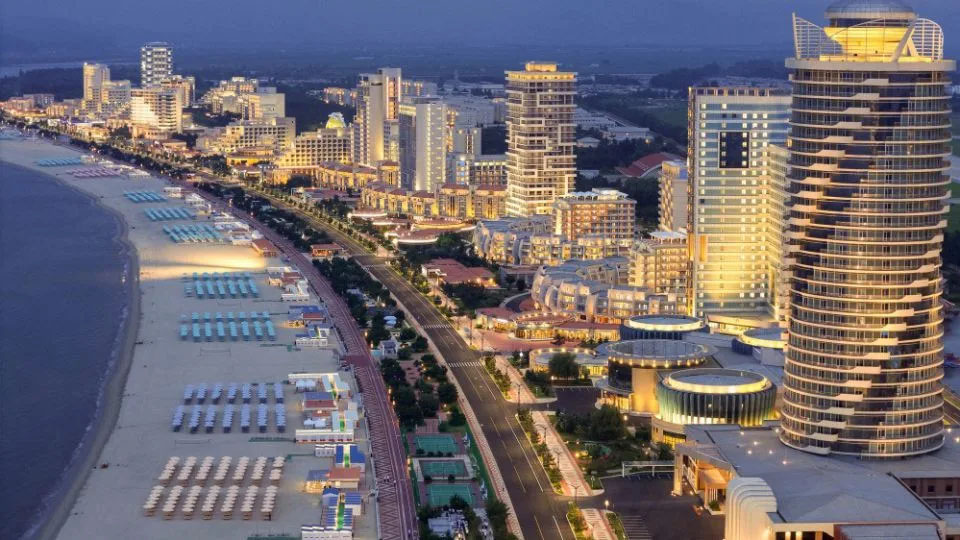
Photo Credit: Getty Images
North Korea has officially opened the Wonsan-Kalma Coastal Tourist Zone, a sprawling beach resort development on the country’s eastern coast. Touted by state media as a “national treasure-level tourism city,” the resort was unveiled in a ribbon-cutting ceremony on June 24, personally attended by Kim Jong Un, his wife Ri Sol Ju, and their daughter Kim Ju Ae—an appearance widely interpreted as symbolic of dynastic continuity.
The resort features waterparks, high-rise hotels, and accommodation for nearly 20,000 guests. While North Korean authorities claim it will begin servicing domestic visitors on July 1, no clear information has been released regarding eligibility or transportation logistics.
The Kalma beach resort stands adjacent to an international airport and is supported by a newly opened train station, moves analysts say hint at ambitions to court foreign visitors. For now, however, foreign attendance is limited. Only the Russian ambassador and staff were present at the opening, reinforcing Pyongyang’s increasing alignment with Moscow as relations with the West continue to sour.
The resort’s launch comes at a time when North Korea remains under heavy international sanctions and its population faces chronic food insecurity. UN human rights chief Volker Turk recently described life in the country as “a daily struggle devoid of hope.” Despite this, Kim appears committed to showcasing projects like Kalma to reinforce his narrative of a “people-first” leadership and to support his long-term economic vision, which includes expanding the tourism sector.
Experts believe the initial audience for the resort will be North Korea’s domestic elite, particularly party officials and their families. Others, like Rachel Minyoung Lee of the Stimson Center, suggest that Russian tourists may soon return to the country, following limited ski holidays offered in 2023. Travel packages to Kalma promoted by Russia-based agency Vostok Intur are already scheduled to begin in July, priced at approximately $1,840.
The project, first announced in 2013, has seen repeated delays due to sanctions and the COVID-19 pandemic. While it symbolizes development and state pride, many experts remain skeptical about its long-term viability as a tourist destination. Dr. Edward Howell of Oxford University noted that the regime’s increasing control over information and citizen movement could hinder any genuine influx of foreign tourism.
As North Korea attempts to polish its image through glittering leisure projects, the question remains: who will be allowed to experience them?






