

Photo Credit: Getty Images
From ancient times, lava has symbolized destruction — a fiery, unstoppable force flowing from Earth’s core, leveling everything in its path. But what if, instead of fleeing from it, we embraced it as a building material? That’s the radical idea proposed by Icelandic architecture firm s.ap arkitektar, whose project “Lavaforming” imagines a future where molten rock is the foundation of sustainable urban development.
Presented at the 2025 Venice Architecture Biennale (running until November 23), Lavaforming lays out speculative strategies for shaping lava into architectural elements like walls, columns, and entire structures. Instead of lava cooling naturally into rock such as basalt, the vision involves controlled cooling methods to mold it into usable building forms. The idea is bold: to redirect the destructive power of volcanoes into a creative, carbon-conscious force for construction.
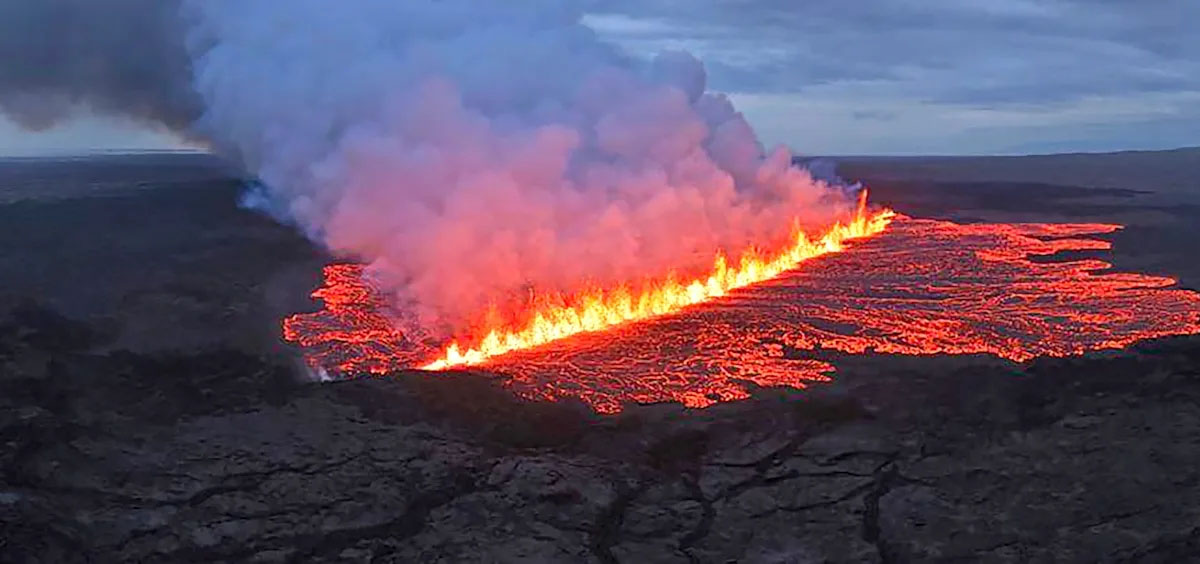
Founded by Arnhildur Pálmadóttir and run alongside her son Arnar Skarphéðinsson, s.ap arkitektar began the project as a thought experiment in response to Iceland’s frequent volcanic activity. During the 2014 Holuhraun eruption, Pálmadóttir recalls thinking, “Wow, we could build a whole city in one week with that.” That realization sparked the ambition to explore lava not as a threat, but as a renewable resource.
Lavaforming also critiques the global building industry’s dependence on concrete — a material responsible for an estimated 8% of global CO₂ emissions due to its carbon-intensive production process. “We think that lava can compete with concrete, but be more sustainable,” said Pálmadóttir. The project focuses on how lava cools: fast cooling results in obsidian (a glass-like material), slower cooling yields crystalline stone for columns, and aerated cooling creates insulating pumice-like material. All are potential replacements for traditional construction materials.
The team proposes three speculative techniques for lava-based architecture. First, trenches dug near active volcanoes could channel lava flows to form structural elements or redirect them to factories that shape bricks. Second, future 3D-printing robots might roam molten landscapes, printing buildings directly from lava. The third method envisions tapping underground magma into custom-built chambers to form prefabricated parts — a concept inspired by geothermal energy systems already in use in Iceland.
While the technological realities are still distant, the concept is grounded in real research. S.ap arkitektar has collaborated with scientists on lava flow modeling and conducted tests reheating volcanic rock to prototype structural forms. These efforts hint at a new way to build in volcanically active regions like Iceland, Hawaii, and the Canary Islands.
Volcanic rock has a long architectural history, from ancient Jordanian fortresses to modern designs like Herzog & de Meuron’s Dominus Winery in California. But s.ap arkitektar’s ambition goes further: to use lava in its molten state as a “mono material” with varied qualities — structural, insulating, and transparent — all formed from the same source, shaped by nature and controlled by design.
Ultimately, Lavaforming is less about utopian fantasy and more about reimagining how architecture can adapt to planetary challenges. “How can we change systems to respond to the global (climate) emergency?” Pálmadóttir asks. Whether or not cities of lava become a reality by 2150, the project pushes us to question how we build, and why — and whether the very forces we fear might one day help us survive.