

Photo Credit: Getty Images
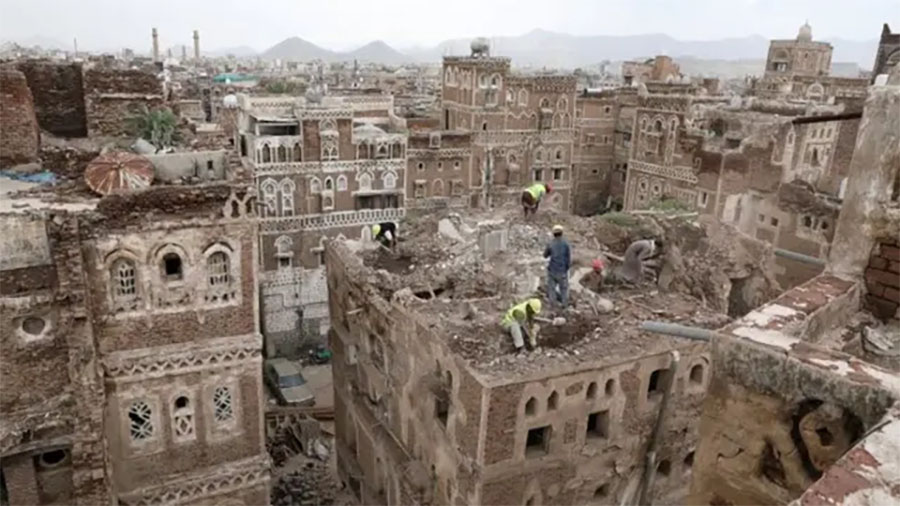
When bulldozers rolled into the Aydid district of Tarim and began tearing down the spectacular mud-brick palace of Abdul Rahman Bin Sheikh al-Kaf, clouds of dust rose into the air, carrying with them fragments of Yemen’s cultural legacy. The demolition of the landmark sparked outrage in the ancient city, where residents gathered in disbelief to witness the disintegration of a palace that had stood for generations.
Local journalist Haddad Musaied rushed to the scene after receiving a call from a friend urging him to “stop what is happening.” But all he could do was document the destruction. His photos and videos, later circulated on social media, showed half of the grand structure reduced to rubble, its once-exquisite interiors – painted ceilings, whitewashed columns, and carved wooden windows – exposed to the open sky. “It was heartbreaking to see Tarim’s history and legacy being quietly destroyed,” Musaied said.
Built between the world wars, Abdul Rahman Bin Sheikh al-Kaf’s palace was among 30 mud-brick mansions that once attracted visitors to Tarim. The city’s wealthy merchant families, particularly the al-Kafs who amassed fortunes in Singapore during the late 19th and early 20th centuries, commissioned these palaces. They combined Hadrami architecture with Southeast Asian influences, resulting in colourful, ornate buildings that became defining symbols of Tarim’s identity.
But years of war and neglect have left most of these palaces in disrepair. Owners, like Mohammed al-Kaf, blame the government for failing to finance restoration. Neighbours worried that the crumbling structures might endanger nearby homes, leaving demolition as the only option. “I blame the government for not supporting us in maintaining the palace,” al-Kaf said.
Tarim’s heritage runs deep. Known as a bastion of Sufi Islam and a historic centre for missionaries, the city was designated the “Capital of Islamic Culture” by Icesco in 2010. Just last month, its cultural significance earned it a place on Yemen’s tentative UNESCO World Heritage list. Yet the recognition has not translated into concrete preservation efforts.
Other palaces face similar fates. Hamtut Palace, once a vibrant residence of the al-Kaf family, now stands abandoned and eroding, its land marked for sale. Al-Quba Palace, repurposed as a hotel before war forced its closure, has partially collapsed, leaving behind ruins and an empty, rubbish-filled swimming pool.
Officials admit the situation is dire. “Most of Tarim’s mud-brick mansions are in a dilapidated state,” said Ahmed Bahamalah of Yemen’s General Authority for Antiquities and Museums. “We are working hard to preserve what can still be saved – but we lack the resources.”
For residents, the loss feels irreversible. “If these palaces collapse, Tarim’s history will be lost, as they are the city’s last remaining living monuments,” Musaied warned. In a country battered by conflict and economic hardship, the destruction of Tarim’s palaces is not only a physical loss, but a slow erasure of memory, artistry, and identity.






