

Photo Credit: Getty Images
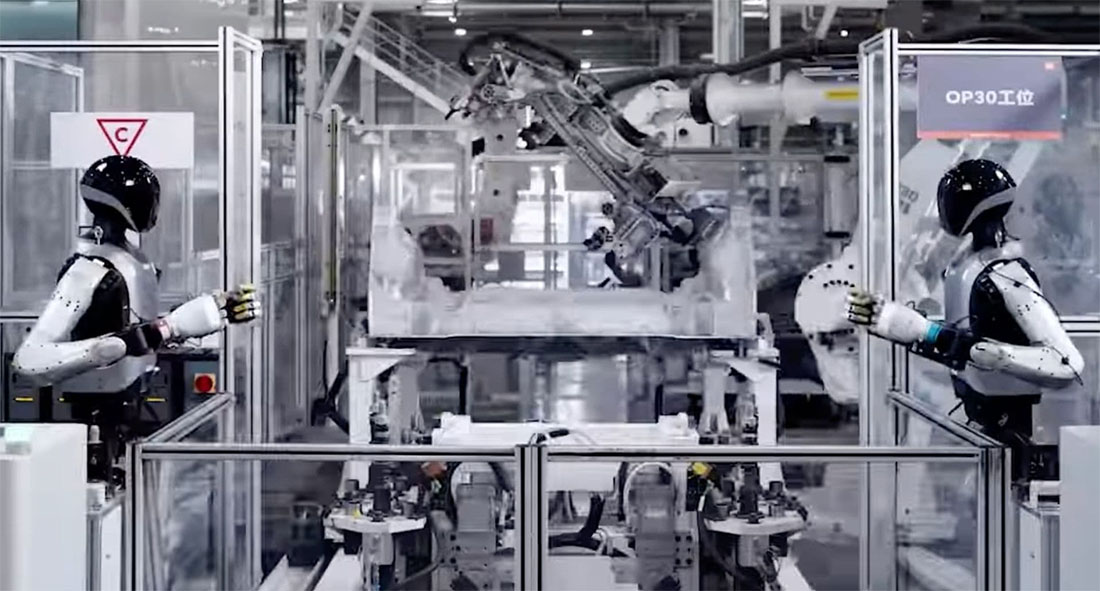
Xiaomi has shared fresh performance data from its electric vehicle facility in Beijing, revealing that its in-house humanoid robots reached a 90.2% success rate during a continuous three-hour production trial.
The pilot centered on a complex station responsible for installing self-tapping nuts onto integrated die-cast rear floor components. According to the company, the robots executed simultaneous dual-side installations while maintaining the factory's 76-second cycle time, the cadence required to match live automotive assembly lines.
Meeting that production beat addresses a frequent industry concern that humanoid systems struggle to operate at real-world manufacturing speeds.
Xiaomi attributed the results to a layered AI software stack. Its Vision-Language-Action foundation model, dubbed Xiaomi-Robotics-0, provides task planning and spatial reasoning. A second system, TacRefineNet, refines grip and alignment in real time using tactile feedback.
By combining head-mounted cameras, wrist-level vision and fingertip sensors, the robots detect spline misalignment, slippage and magnetic interference before errors cascade into failures. The approach targets what researchers often call Moravec's paradox, the idea that fine motor control can be more difficult for AI than abstract reasoning.
On the hardware side, Xiaomi deploys a hybrid motion control framework. A Quadratic Programming optimizer maintains balance and safety constraints in under one millisecond, while a reinforcement learning controller, trained on billions of simulated disturbances, enables rapid recovery from unexpected physical disruptions.
The company said this simulation-first strategy enabled zero-shot deployment, meaning the robots transferred balance policies from virtual training directly onto the physical factory floor without manual recalibration.
While Xiaomi acknowledged common failure cases, including jams and visibility constraints, it is expanding validation to additional stations. By testing robots inside its own EV operations, the company is positioning itself as both developer and end user in the accelerating race toward large-scale humanoid deployment.






