

Photo Credit:Getty Images
Millions of people across the United Kingdom and Europe turned their eyes toward the sky as a spectacular solar eclipse created one of the region's most dramatic astronomical events in decades.
The United Kingdom experienced a partial eclipse, with the Moon covering more than 90 percent of the Sun across much of the country at the event's peak shortly after 19:00 BST. Parts of Cornwall experienced coverage of as much as 95 percent.
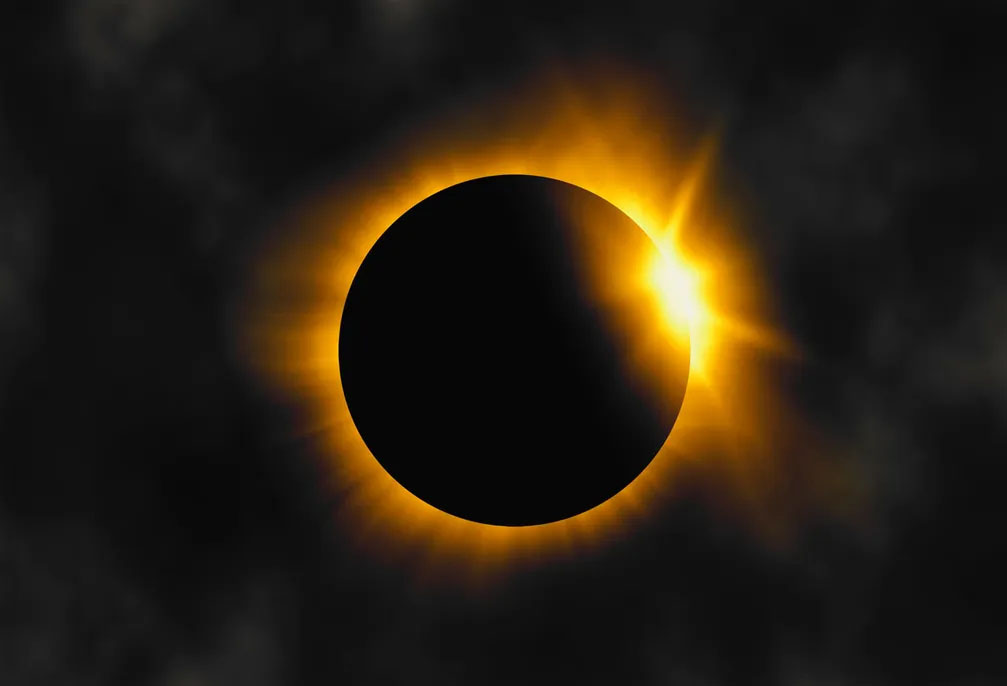
The spectacle was even more dramatic in Greenland, Iceland and parts of Spain, where observers witnessed a total solar eclipse and experienced the brief darkness created when the Moon completely blocked the Sun.
In the UK, the eclipse began shortly after 18:00 BST in northern Scotland and just before 18:20 along England's south coast. As the Moon gradually moved across the Sun, spectators watched the daylight change and the visible portion of the Sun shrink.
Central and southern England, along with Wales, benefited from clear skies, allowing large crowds to watch the event. Northern England, Scotland and Northern Ireland experienced cloudier conditions, but thousands still gathered at popular viewing locations.
Demand for solar eclipse glasses surged before the event, with supplies becoming difficult to find at many shops and online retailers. Some people improvised by using objects such as colanders and cereal boxes to create safe viewing methods.
A solar eclipse occurs when the Moon passes between Earth and the Sun, blocking some or all of the Sun's light and casting a shadow on Earth. During a partial eclipse, the three bodies are not perfectly aligned from a particular location, meaning only part of the Sun is obscured.
For observers in Spain, the experience was considerably more dramatic. At approximately 19:30 BST, the Sun, Moon and Earth aligned perfectly, creating totality. The brief period of darkness lasted less than two minutes but produced cheers and emotional reactions from spectators.
During totality, the Sun's corona became visible around the darkened Moon. The corona consists of extremely hot gas extending outward from the Sun, while some observers may also have seen prominences, loops of pinkish gas shaped by the Sun's magnetic activity.
Although total solar eclipses occur somewhere on Earth roughly every 18 months, they are exceptionally rare from any individual location, occurring approximately once every 400 years.
For Britain, Wednesday's eclipse was the country's most dramatic since 1999. The next significant partial eclipse visible in the UK will occur in 2027, with some areas receiving around 45 percent coverage.
Britain will have to wait considerably longer for another major eclipse. In 2081, up to 99 percent of the Sun will be covered, while the country's next total solar eclipse is expected in 2090.
For those who witnessed Wednesday's event, however, the wait was hardly the point. For a few unforgettable minutes, millions were reminded of the extraordinary scale and precision of the universe.