

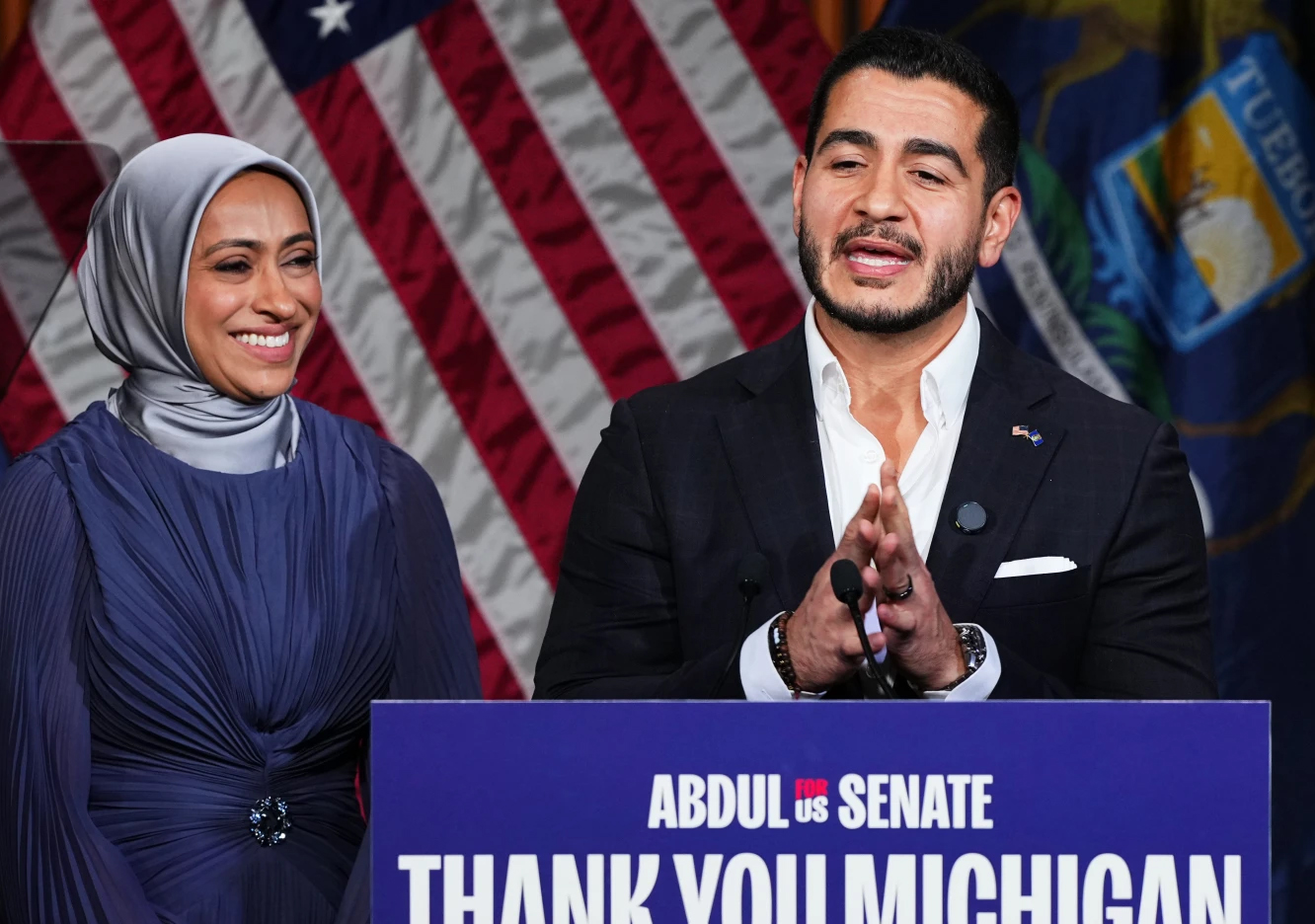
Photo Credit: Getty Images
Campaigning relentlessly across Michigan, Abdul El-Sayed didn’t highlight the possibility that he could become the first Muslim elected to the U.S. Senate. But with victory in hand, he savored his triumph over the vitriol aimed at him and his fellow Muslim Americans.
“They tried to demonize people because of how they pray,” he told The Associated Press on Wednesday. “And Michigan — the whole Michigan — clapped back. People don’t want that. They’re sick of it.”
He showed his pride in his victory speech, declaring: “My name is Abdulrahman Mohamed El-Sayed.”
Twenty-five years after the Sept. 11 attacks and their aftermath yanked anti-Muslim sentiment into the forefront of American life, those emotions are shared by many Muslim Americans in Michigan and across the country.
They saw a surge of anti-Muslim rhetoric after Zohran Mamdani’s election as New York City mayor a year ago, and they saw the attacks intensify as El-Sayed became the new prime target. President Donald Trump called him a “jihadist” who was “on the side of the terrorists.” Dozens of Trump’s fellow Republicans in Congress formed a Sharia-Free America Caucus, depicting Islam’s religious code as a threat to the U.S. Constitution.
But now, after El-Sayed’s defeat of GOP rival Mike Rogers was confirmed early Wednesday, there is a pervasive sense that a broader victory is at hand.
The outcome “represents a historic turning point for American Muslim political engagement and a historic defeat for the politics of hate,” said Nihad Awad, national executive director of the Council on American-Islamic Relations.
“Anti-Muslim extremists, Israel lobby groups and even the president of the United States used every smear in the book to paint Dr. El-Sayed as a Muslim boogeyman,” he said. “None of it was true, and none of it worked. Anti-Muslim hate was on the ballot, and it failed.”
Excitement over El-Sayed’s victory was palpable in Dearborn, a city near Detroit with a sizable Arab American population. The mayor, Abdullah Hammoud, said residents showed up at the ballot box in huge numbers.
“What a beautifully American story,” Hammoud said. “One of our brightest and best earned the support of the majority of Michiganders who participated in yesterday’s election. And regardless of the direction in which he prays, they’re sending him to the U.S. Senate.”
Hammoud, who has known El-Sayed for more than a decade, said although his win was important for many Arab Americans, people voted for him because of his platform, not his identity. He cited support in Dearborn for independent Vermont Sen. Bernie Sanders’ 2016 presidential campaign. Sanders, who is Jewish and caucuses with Democrats, ran on a progressive platform.
In El-Sayed, residents of Dearborn “finally saw themselves and a candidate who appealed to them, but it had to do with far more than just his ethnicity or his religion,” Hammoud said. “It was honestly because of the policies and building a coalition with this community in an honest way.”
When Zaynah Jadallah, 26, canvassed for El-Sayed in Dearborn, she said most people told her they already planned on voting for him before inviting her in for water or food. She credited the name recognition to El-Sayed’s grassroots campaigning and his pride in his Egyptian heritage.
“He’s always been proud of his identity. He never shied away from it or from saying his name,” Jadallah said.
Yasmin El-Sayed, no relation to the senator-elect, took her two daughters to the Detroit watch party from New York. She teared up after the victory speech.
“Having grown up in a post-9/11 world, being Muslim, being Arab myself, never in a million years did I think we would see what we saw today,” she said.