

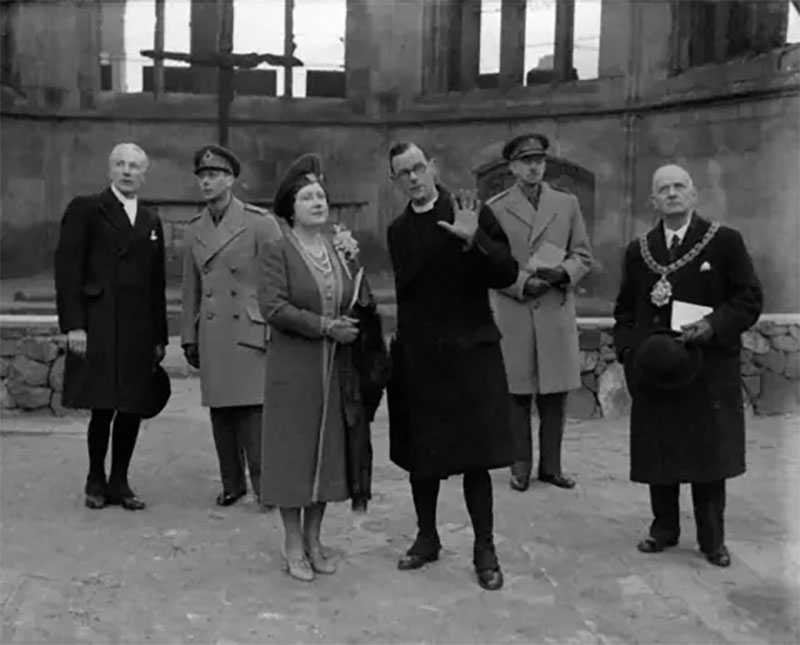
Photo Credit: Getty Images
On Christmas Day 1940, just weeks after the devastating Coventry Blitz, a small congregation gathered among the ruins of Coventry Cathedral for a service that would resonate far beyond the shattered city. The medieval cathedral had been largely destroyed on the night of 14 November when German bombers dropped hundreds of tons of explosives and incendiaries, reducing much of Coventry to rubble. Yet from this scene of destruction came a message of forgiveness, hope, and peace that would shape the city’s identity for decades to come.
The Christmas Day service was broadcast live across the nation. Standing amid the broken walls and fallen stones, Provost Richard Howard addressed the country and the wider Empire. Rather than calling for vengeance, he urged people to banish thoughts of revenge and to look toward reconciliation. His words were striking given the fresh wounds of war and loss, and they set the tone for what Coventry Cathedral would come to represent in the years ahead.
The service concluded with the choir singing the Coventry Carol, a piece of music deeply bound to the city’s history. Though now widely regarded as a Christmas carol, it is not a song of simple celebration. As city historian Malvern Carvell has explained, the Coventry Carol originated in medieval Mystery Plays performed in the city from at least the 14th century. These religious dramas told stories from the Bible, and the carol accompanied a scene depicting the Massacre of the Innocents from the Gospel of Matthew.
The lyrics imagine mothers softly singing to their children as King Herod’s soldiers approach, ordered to kill all male infants. The gentle refrain masks a moment of terror and grief. It is a lullaby shaped by fear rather than joy. As Mr Carvell notes, it is not what most people would consider normal Christmas cheer. Its power lies in that tension between tenderness and horror.
The earliest surviving written record of the Coventry Carol dates from 1534 and was associated with a play staged by the Guild of Shearmen and Taylors. Although one historic copy was later lost in a fire, the carol survived through other records and saw renewed interest in the nineteenth century. Over time it moved beyond Coventry and entered wider public consciousness. There is even speculation that William Shakespeare may have seen the Mystery Plays during his lifetime.
In the modern era, the Coventry Carol has been recorded by many artists and has appeared in popular culture, including the 2009 film Nativity, set in Coventry itself. The film draws directly on the unsettling themes of the Massacre of the Innocents, highlighting how deeply the carol’s story remains woven into the city’s cultural memory.
Since the Blitz, Coventry Cathedral has become an international symbol of reconciliation. The ruined cathedral, left standing beside the new one, bears the words Father Forgive carved into its walls. The Coventry Carol continues to echo that message. As Rev Kate Massey has observed, the song reflects the experience of parents across history and across the world who cannot shield their children from danger but can still hold them and offer comfort.
For all its sadness, the Coventry Carol endures because of its quiet beauty. Sung among ruins in 1940, it transformed a moment of immense loss into an appeal for peace. It remains a reminder that even in the darkest times, compassion and humanity can still find a voice.