

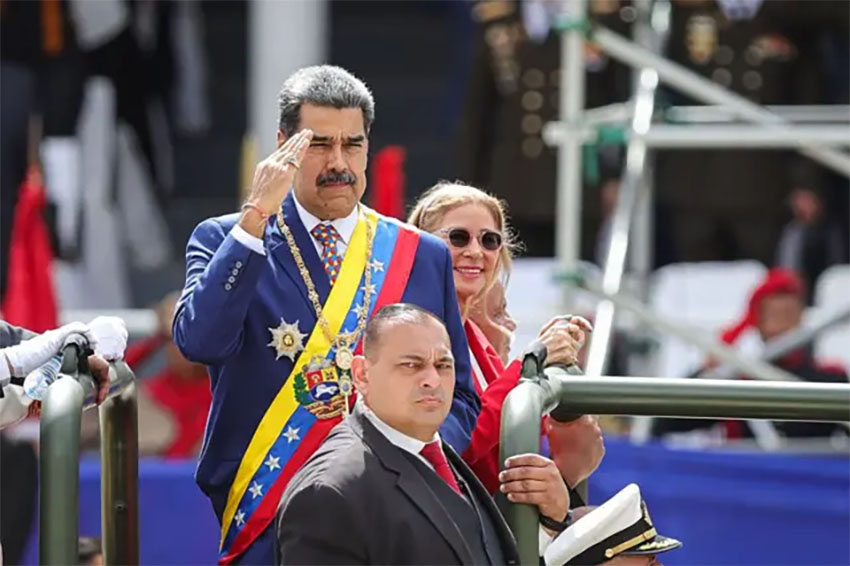
Photo Credit: Getty Images
Venezuela has intensified its standoff with the United States by banning six major international airlines after they failed to resume flights within a government-imposed deadline. The carriers, including Iberia, Avianca, Gol, Latam, TAP Portugal and Turkish Airlines, suspended operations following a US warning citing heightened military activity around Caracas. The Venezuelan government viewed this suspension as an act of political alignment with Washington and consequently revoked their landing rights immediately.
The dispute unfolds against the backdrop of one of the most significant US military deployments in the region since the late 1980s. The United States has stationed approximately 15,000 troops and the aircraft carrier USS Gerald Ford near Venezuela, officially to combat drug trafficking. Washington claims that multiple targeted strikes have eliminated boats allegedly transporting narcotics, though analysts argue that the scale of the deployment far exceeds traditional counter-narcotics missions. The Venezuelan government considers the operation a pretext to destabilize or potentially remove President Nicolás Maduro, whose contested reelection continues to divide international opinion.
As tensions rose, the US Federal Aviation Administration issued an advisory urging commercial airlines to exercise maximum caution when operating near Caracas due to military activities and potential airspace risks. The banned airlines complied with the warning, prioritizing passenger safety, but their decision drew harsh criticism from Venezuelan authorities. Officials accused the carriers of enabling what they described as "state terrorism," further escalating the diplomatic rift.
Thousands of travelers now face significant disruptions with only smaller regional carriers maintaining service. Efforts by the International Air Transport Association to mediate were swiftly dismissed by Venezuela, which insisted that foreign airlines must not bow to external political pressure. Meanwhile, diplomatic dynamics shift unpredictably as both Maduro and US President Donald Trump have signaled openness to direct dialogue, although neither has outlined terms for negotiation.
Inside Caracas, Maduro has attempted to reassure citizens by highlighting public festivities, including the city's Christmas decorations, portraying a sense of stability despite the geopolitical strain. However, concerns remain high as the aviation bans risk deepening Venezuela's international isolation and threatening its already fragile economy. With uncertainty looming over regional alliances and air travel safety, the ongoing tensions reflect a broader struggle for influence and legitimacy in one of Latin America's most politically volatile nations.






